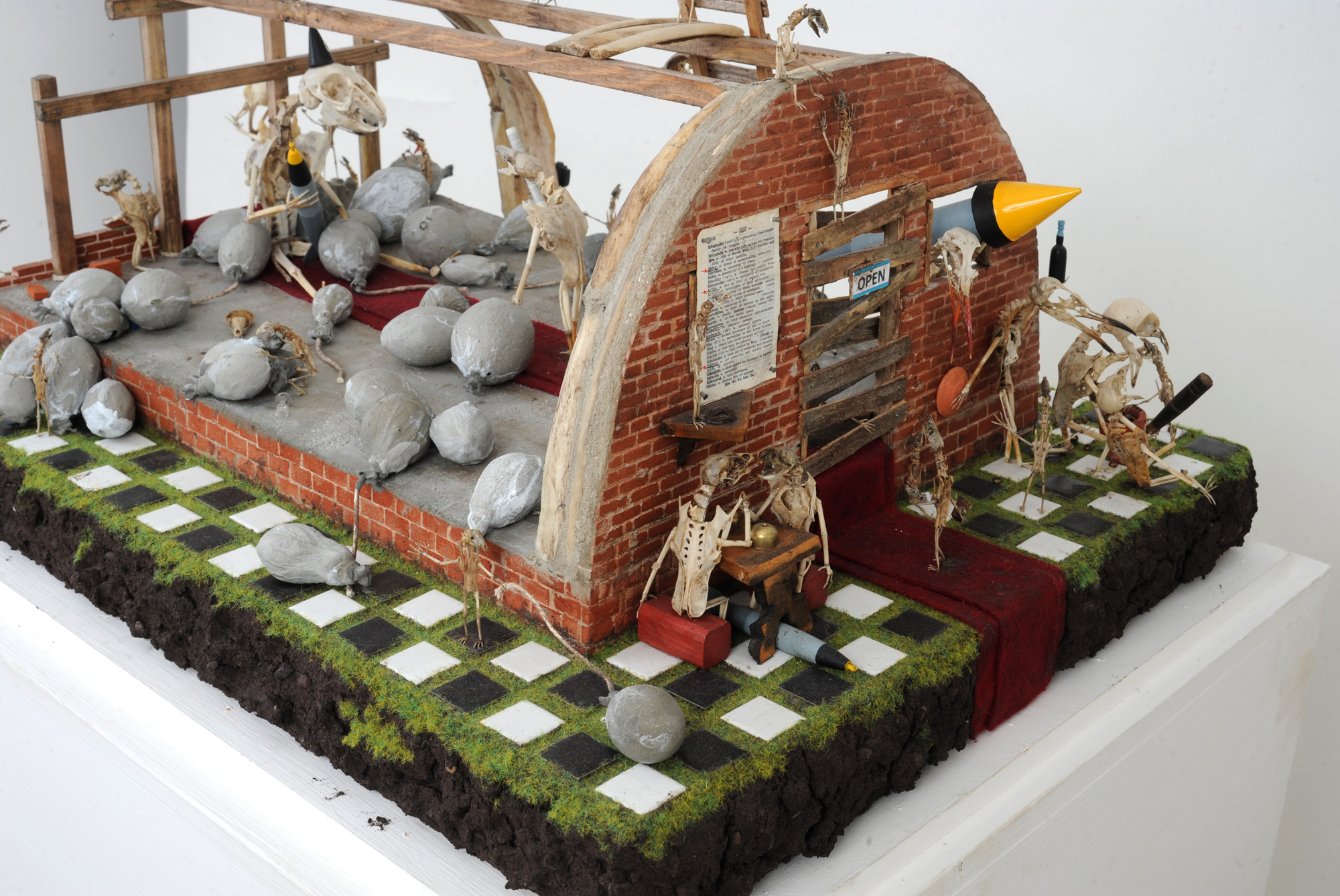
Peter Hanmer, a sculptor and installation artist from the north-east of England, has a distinctive love of allegory. His dioramas are populated by figures slightly less than human: little men with clown’s faces and beaked noses; humanoids made of bone. The beaked figures are usually wreaking havoc, while the terrifying humanoids are staging elaborate rituals – punishments and exaltations taking place around weird structures made from the same bones as the humanoids. Contained in glass domes, mounted to the wall, or sinking into a bathtub filled with mud, these scenes suggest a rich array of allegorical meanings. They’re bleakly, blackly funny, arresting and absorbing.
There’s not much from which Hanmer’s work obviously derives. His irreverent energy might recall the installations of Jake and Dinos Chapman, in whose desolate wreckage a grinning Ronald McDonald struts and prances and tiptoes. Hanmer shares their sensitivity to the nightmarish aspects of contemporary consumer culture, its ability to insinuate itself into our heads with its gaudy little personages, and – like rubber ducks on the ocean – to withstand seemingly all forms of degradation. But he is less interested than the Chapmans in being splashily shocking. As in the hellish ends of Hieronymus Bosch’s great altarpieces, it’s not only the frightful things that people do which are of note, but also the compulsive zeal with which they do them. (Everyone in Bosch’s hellscapes seems so horribly busy.)
Allegory, since Coleridge juxtaposed it unfavourably with symbol, has had a bad press in most forms of art criticism. Both allegory and symbol, in the post-Coleridgean view, connect images with wider, figurative meanings. But whereas the symbol’s figurative meaning is somehow inherent, shining through it, the allegorical image’s hidden meaning is held to be external, yoked to it with artifice. That sense of an arbitrary yoke has saddled allegory with a reputation for tedious, dogmatic heaviness. Its correspondences are presumed to be one-to-one: if Snowball is Trotsky and the Old Major is Marx, then – ploddingly – Boxer’s the proletariat and Napoleon must be Stalin.
One way of defending allegory is to celebrate the strange effects of this laboured yoking of image to idea. Walter Benjamin finds in The Origin of German Tragic Drama (1928) the melancholy of allegory, its mourning for a remote world which cannot be revived into signification.[1] For Benjamin, allegory shows us human history and temporality violently invading perfect symbols, collapsing the total, mystical belief system on which those symbols relied. Yet this rehabilitation of allegory, as a mode secretly harbouring modern consciousness within itself, forgets a quality acquired by allegorical poetics in the Renaissance. There, allegory sheds its tortured need for one-to-one correspondences and becomes more like hieroglyphics: a set of shadowy, enticing metaphors which point towards a dazzling multiplicity of meanings. In the words of its most influential living theorist, allegory ‘opens more spaces than it can close’; yet if it (and we) accept this, it becomes a deft mode of infinite suggestiveness.[2]

Hanmer’s first solo show, Seeking Armageddon, cuated by Jed Buttress and exhibited at Newcastle’s Arts Centre in October and November 2022, summarised his work so far. Interspersed with the dioramas were pen-and-ink drawings and nightmarish sculptural sequences mounted on wooden shelves: a series of heads on spikes, skulls protruding from flowerpots, each in different get-up (top hat, two cigarettes in the mouth; rubber chicken). Everything is small and intricate, which suggests the inherent affinity of the allegorical mode with the miniature. Hanmer’s figures and structures signify in the manner Susan Stewart observes in On Longing (1984): ‘a signification which is increased rather than diminished by its minuteness’.[3] Stewart contrasts the miniature painting with the miniature book,[4] arguing that whereas the former miraculously heals the distance between signifier and signified, the latter ‘delights in tormenting the wound of that relation’.[5] Squint at a beautiful French or Rajasthani miniature painting and you delight in a flawlessly realised, proportioned world; cradling a miniature Renaissance bible, you contemplate letters far too small to be read, but which (in larger editions) have immeasurably altered the world. Yet Hanmer’s miniature sculptures, neither painting nor text, evade Stewart’s distinction. Though meticulously and cleverly made, they deny us the satisfaction of perfect resemblances. They force us, tauntingly, to ponder the many things they could mean.
These works seem alive not only to the miniature’s aesthetics, its allegorical suggestiveness, but also to the political valences of that aesthetics. Unlike a miniature painting, the diorama occupies three-dimensional space, forcing us to move carefully around it; unlike a miniature book or object, it can’t be held or carried. The miniature diorama possesses a coercive theatricality, pulling the viewer in, compelling her close attention. Everywhere rituals are taking place, in buildings of special significance, variously connoting prisons, temples, laboratories. Atop a wooden promontory raised on a scaffold over black soil, a bone figure holds up a pale, pouting rubber duck. He seems to be venerating it, or about to throw it to its death. A barn-like storehouse, from which garish little missiles protrude, hoards a black-and-white football like a sacred object. Elsewhere a (relatively) giant bone figure, his colossal legs straddling an obsequious assistant while his hands gesture with passion, rants from the top of a totem-like clock tower; at his feet a minuscule red phone box lies on its side.
Just as we are drawn in by the macabre drama of these scenes, and their uncanny minuteness, so the minor characters within them are enthralled: little men stand around in awe, investing these rituals and ceremonies with sacredness. Yet that inwards movement is countered by fearful exclusion. The bony humanoids anxiously guard their special places from access: the storehouse proclaims itself ‘OPEN’ from a sign stuck onto the planks which block its doorway. They want us to watch, but not to enter. Their bodies are monstrously disproportionate, with spindly torsos supporting grotesque jawlines; they’re all mouth. KEEP OUT, they all seem to say.
*
One scene explores in particular depth this dynamic of hostile spectacle with its ambivalent demanding and rebuffing of attention. In a brighter key than the bone sculptures, Keep Your Distance replaces humanoids with little figures the size of Action Man. Two of them wear masks, an allusion to the stock figures from commedia dell’arte (but also suggestive of an archetypal evening of contemporary excess, an orgiastic party of the ruling classes, hosted at 5 Hertford Street or somewhere near Chipping Norton, by someone who went to school with Carrie Symonds). Three of them occupy a wooden shelf, on the edge of which balance five pool balls, neatly alternating garish yellow and red. A yellow smiley face is printed on a grimy flag which flies in one corner. They’re engaged in wanton destruction. The central figure wears a sky-blue bow tie and a ringmaster’s top hat and jacket; he wields a croquet mallet, scowling at the yellow ball he is about to whack. To his left, a blue-trousered gent sits dangling his legs off the shelf, top hat by his side, resting his own mallet while he enjoys a tea break. At the other end, the third figure bends to roll a red off the shelf, to its doom.

Destruction, in the internal logic of the diorama, would also be a fatal kind of animation. If the croquet mallet came swinging down the ball would roll forward, out of its fragile order, and off the cosy snugness of the shelf, towards us. The sculpture would be brought to full, three-dimensional life even as its parts fell to their death. (Hanmer’s sensitive to the uncanniness not only of stillness, but also deathly kinds of motion: one sculpture, a skeletal figure crouching in the cockpit cut out of a stocky little warhead, invites the viewer to press and hold the red button; the rocket writhes on its tether, lamely and pointlessly, like a post-nuclear nightmare of a bucking bronco.) Whatever these guys are possessed with, it’s not far from the death drive: they’re full of rubber plans to get rid of themselves, but they want to take us with them.
Behind the three chaps the shelf is littered with rubble, and close inspection reveals a subtly hidden horror: the body of a fourth man, buried beneath the fragments. Having spotted this unfortunate victim of his own vandalism, I peered as close as the sculpture would permit me, and laughed out loud when I saw what was printed on the mugs in tiny neat capitals, white letters on a red background: KEEP CALM AND CARRY ON.
That slogan, with a crown presiding over its alliterated commands, quickly became the backdrop to the UK’s experience of the Great Recession. A copy of the original wartime poster had been rediscovered in Barter Books, a cavernous and magical second-hand emporium in Alnwick. The bookshop’s owners reprinted the poster and sold 50,000 copies by 2007, but it was only once the financial crisis bit in 2009, and talk began of weathering a coming storm, that sales took off. Rupert Grint and Katie Price wore t-shirts bearing the slogan, and suddenly it was everywhere: keyrings, stickers, Facebook pages, and – as in Hanmer’s sculpture – mugs. Almost immediately it mutated, spawning variants: small pleasures (KEEP CALM AND EAT CAKE; KEEP CALM AND DRINK TEA), and passive-aggressive encouragements (KEEP CALM, THERE’S A SPREADSHEET FOR THAT; KEEP CALM AND LOVE YOUR JOB). The designer Matt Jones wasn’t impressed, and released an alternative on a t-shirt: GET EXCITED AND MAKE THINGS.
*
You could narrate the history of the last twelve years of Tory rule through its slogans, each more dishonest than the last: Keep Calm, Take Back Control, Strong and Stable, the Rule of Six (Except at Downing St Parties), Protect the NHS (But Don’t Pay Nurses Anything). For Tom Whyman, in his scorching and playful essay ‘Cupcake Fascism’, the Keep Calm posters epitomise the profoundly reactionary spirit of the Cameron years. Whyman reserves special loathing for the slogan’s most cloying adaptation, ‘Keep Calm and Eat a Cupcake’, in which a cutesy cake replaces the imperial crown. Whyman fears the cupcake: it’s ‘vintagey and twee’ and belongs, as a cultural trope, with ‘the drinking of tea and gin and the lisped strumming of ukuleles’. In a crisis, Whyman argues, any call for things to proceed as normal is reactionary and false; the silver lining of a crisis is to reveal the problems with the status quo, to open up the possibilities of change. He reads the original exhortation to Carry On as an inducement to passivity, part of what he diagnoses as a mass infantilisation of the obedient middle-class subject: ‘accept existing conditions, swallow your anger, swallow your pride’.[6]
The poster was created by the Ministry of Information in the first phase of the Second World War. A trio of messages, intended to build patriotic support and unity while providing reassurance, was unveiled in August 1939, but the first two slogans – ‘Freedom is in Peril’ and a long-winded declaration that ‘Your Courage, Your Cheerfulness and Your Resolution Will Bring Us Victory’ – met such a cool reception that the Keep Calm poster, intended for an intense attack which hadn’t materialised during the Phoney War, was shelved. Whyman slightly flattens this story, asserting that the poster was ‘considered by those who saw it at the time to be patronising’. By the time the existential attack did come, in the form of the Blitz, the poster had probably been pulped.[7] And its stoical exhortation was not originally an encouragement to ‘accept existing conditions’, because existing conditions suggested that military defeat was inevitable. The slogan is certainly an improvement on those which preceded it. It possesses dignity and power.
Whyman is quite right, however, about the slogan’s hollow deployment in the Cameron years, and the culture of twee reaction to which its revival belonged. He’s right about cupcakes. The early part of the last decade, the age of the cupcake, thronged with the twee: knitted jumpers and quilted jackets; vintage haircuts rearing their short back and sides; businesses with disarmingly simple names (‘The Bacon Shop’) selling good honest stuff (bacon); Mumford and Sons. The Great British Bake Off began in 2010 and as of 2022 there are no signs of an armistice. Overdue conversations about national identities in this archipelago were avoided by the invocation of a Britishness trivialised even as it was venerated: a sprawling, ambiguous post-imperial culture reduced to a set of small and charmingly quaint signifiers, like the tiny red phone box upended at the top of Hanmer’s tower.
There are worse sins than craft gin and pumpkin spice lattes. So many of these phenomena were benign in themselves, even well-intentioned. But they created a national mass culture which insidiously convinced us that we were living through a repeat of the 1940s. That message did terrible damage. It made austerity impossible to oppose, casting it as an economic inevitability rather than a political choice, a trial imposed from without and – like the Blitz – to be stoically endured. It’s often overlooked that this demonstrates Cameronism’s divergence from Thatcher: none of the zeal carried over, the conviction that from the ashes of rapid deindustrialisation prosperity would miraculously grow; austerity for Cameron and Osborne was simply the only possibility, and we were All In It Together. It also insults the suffering of the war generation. Not many of those who slept in air-raid shelters and Underground tunnels in 1940 can have felt grateful for having a character-building experience. They wanted peace and the defeat of fascism, not a cupcake for making it through Monday.
*
Whyman’s essay appeared in 2014, and manages to be both prescient and of its time. Writing before the wave of so-called ‘populism’[8] in the second part of the decade, Whyman is able to state that ‘nowadays racism is very niche-appeal’. His analysis of contemporary fascism emphasises its difference from its classical form in the age of the original short back and sides. Today’s reactionary voices speak not to menacing passions but to bourgeois rectitude: the social malaise at the root of the 2011 riots was smothered by a wave of nice people volunteering to clear up the streets.
Fascism in the 1930s was a young man’s game and today’s western societies are ageing. First-wave fascism sold a terrifyingly cruel but terrifyingly ambitious vision of the future, as well as exploiting grievances about recent humiliation. Today, fascism’s spin-off trades only on nostalgic versions of the imagined past. Of course, racism has entered the mainstream in western politics the way it hadn’t in 2014, and among other countries both Britain and America have been governed by politicians playing fast and loose with democratic conventions. Yet even Trump represented something distinct from classical fascism. ‘Cupcake fascism’ is a knowingly provocative diagnosis, but it argues as much for the newness of today’s reactionary moment as its harking back. This holds true even in Russia, Europe’s most violently authoritarian nation. Putin’s reactionary assault on liberalising Ukraine proceeded not by whipping up its population but by trying to dulcify them. The original strategy was to resist mobilisation of any kind, military or metaphorical; instead of talk of a heroic war there was a ban on such language. There was a confusing onslaught of disinformation designed to bewilder, mixed with reassurance of business as usual in the Motherland. This has been ongoing since 2014, the effective beginning of Putin’s war in Ukraine. The annexation of Crimea, without violence but by force, was overseen by soldiers in unmarked uniforms. That summer they appeared on celebratory calendars. In Russian they were called ‘polite people’; in English, ‘little green men’.
In a contemporary light, Whyman’s essay seems boldly perceptive for locating at least some of today’s reactionary spirit in the national culture of the Cameron years. A liberal centrist narrative has taken hold in which at some point in the mid-2010s – usually 2016, the dawn of Brexit and Trump – western societies were suddenly consumed by populist irrationality, chauvinist sentiment and (horror of horrors) politicians not telling the truth! But as well as disclosing its own unacknowledged preoccupations – accuracy and accountability, managerial competence, temperate rationality in all things – this narrative is obviously insufficient. Politicians distorting, editing and even abusing the truth is an essential feature of democracy: people in a robust society should be dignified with the power to decide which warpings can be forgiven and which can’t.
Any notion that before 2016 we lived in an age of technocratic expertise can be dismissed in a stroke by a rehearsal of Cameronism’s economics. Austerity was sold to us with a set of cosy, intuitive metaphors, none of which had anything to do with empirical reality: the economy as a household, government borrowing as the cause of the recession, debt as the primary evil, suffering as good for the soul. In this respect Cameronism qualifies as what political scientists Chris Bickerton and Carlo Invernizzi Accetti have called ‘technopopulism’ – a politics which denies that society is made up of parts whose interests and priorities might clash; which sells society an image of itself as a homogenous whole, in possession of agreed truths to which governments cannot but remain bound.[9]
*
Reading Whyman’s essay today prompts the question of how exactly the age of cupcake technopopulism relates to the right-populist reactionary politics of the present. It’s on this question that Hanmer’s Keep Your Distance, with its teasing allegorical suggestiveness, is usefully thought-provoking. If the mugs urging us to Keep Calm And Carry On connote the recent past, and the miniature men’s wanton destructiveness suggests the present, how do the eras relate? We might think that the anodyne pacifying sentiments expressed on the mugs have served the mallet-wielders well; yet they might also have forgotten those sentiments, contemptuously relegated them to the domestic trivial – a mug to laugh at, as you break for tea in the middle of wrecking the institutions around you. On the left of the shelf, as we look at it, lie tiny red shards. When they’re done, will they smash the mugs they are holding, like a teatime version of the Bullingdon Club?
Understood as an encoded narrative, Keep Your Distance suggests a story of how Cameronism, with its twee slogans and manufactured consensus unleashed forces it couldn’t control. Cameron and Osborne won (or nearly won) two elections by convincing the country that the economy functioned like a household, that Labour caused the recession with its over-spending, and that reducing the deficit took inarguable priority over funding public services. A national print media imbalanced towards the right, and brazenly illiterate in macro-economics, helped drive this message home. Between 2010 and 2015 everyone, save a few beleaguered voices on the left, chorused agreement; even Ed Miliband found himself forced to accept austerity’s founding principles. Yet it’s rarely acknowledged that this messaging also created the conditions for the pro-Brexit rhetoric which ultimately swallowed Cameron and his allies. Insist that there is no alternative to austerity, and that everyone just needs to Keep Calm, and you make it possible for your opponents, a few years later, to insist with equal airiness that leaving the EU will cost nothing and deliver everything.
Since 2016, arguments about the economy, and everything else, have been polemical and divisive. In 2010 they were bizarrely, falsely consensual. The pseudo-reason of the KEEP CALM mug has yielded to the stupid grin of the face on the yellow flag, the delight taken by the shitposting right-wing troll, who advocates a bonfire of liberal principles and pieties but claims to mean nothing he says. What is consistent, however, is the philistinism of the conversation, its clinging to easy intuitions, its contempt for expertise. Highly fractious, the politics of today is undoubtedly a sharp departure from the Cameron years of fake consensus. At the same time, it’s their natural consequence, and Keep Your Distance, with its artful allegory, captures this complex relation. The story is one of rebellion, in which a period of fake consensus and excessive realism is followed by one of rancour and reckless risk-taking. But it’s also a story of consistency: of folksy, nostalgic political rhetoric simply achieving its final form.
*
Our politics is a cacophony of hollow words: mixed metaphors, party lines, soundbites and slogans. We know what’s behind this: the rise of mass media and the culture of the spectacle; the growth of advertising and its entry into politics; New Labour’s professionalisation of political communications and obsession with courting and controlling the media. Like truth-bending, slick messaging is an essential ingredient of democratic culture, and in fact precedes it: only a patronising historical attitude which assumed that pre-modern people were incapable of cunning could blind us to the ancientness of political skulduggery. What’s distinctive about the present era is not the volume of sloganeering but the absence of anything else, the fact that recent governments have treated messaging as the only priority, an end in itself. It didn’t really matter to Johnson that he never worked out what he meant by Levelling Up: it had won him votes in the so-called ‘Red Wall’, and it got his ministers out of tight spots in interviews.
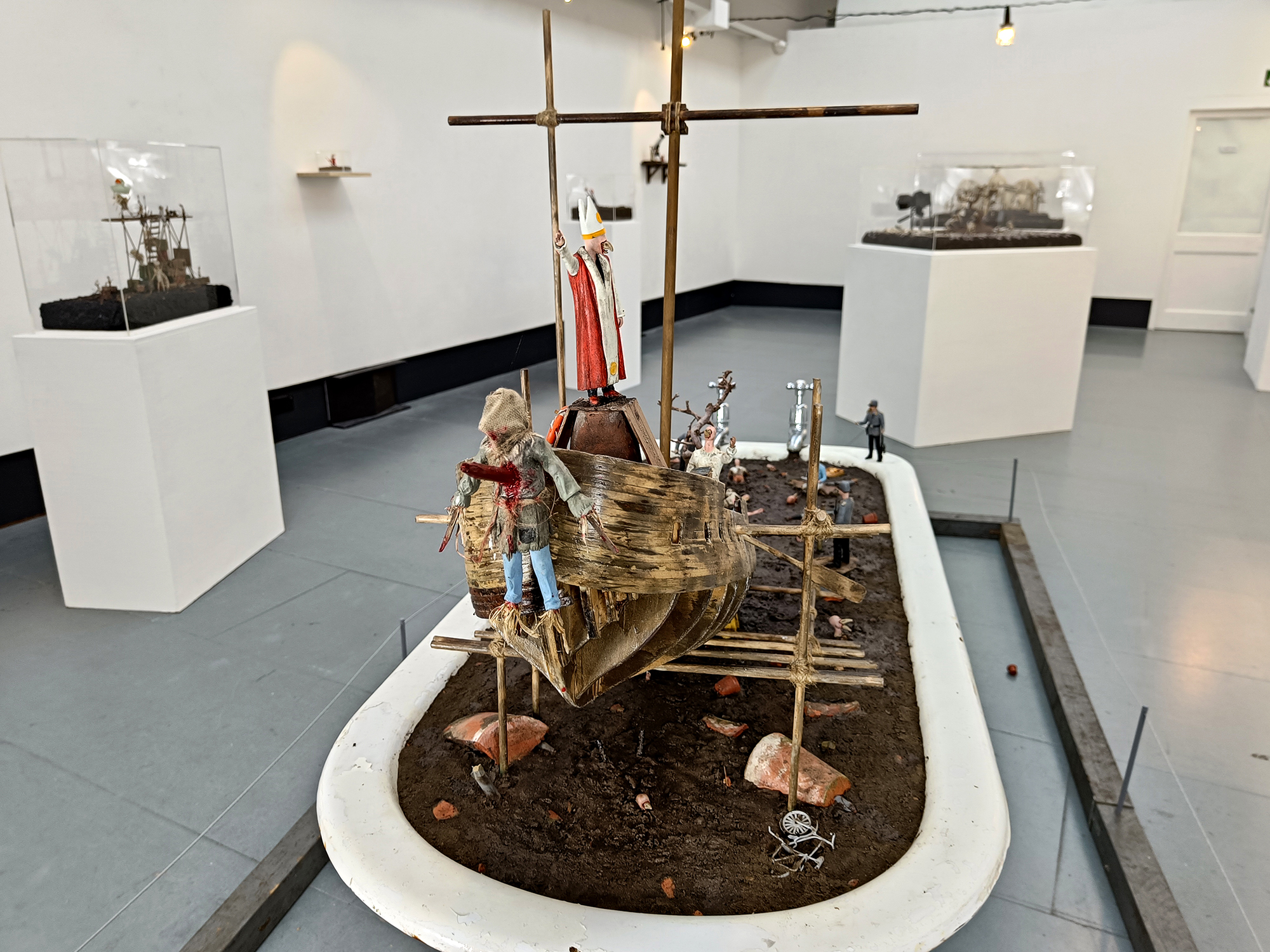
Furthermore, the jangling slogans sound in a landscape of dysfunction and decline. Are Hanmer’s crazed men drinking from their cups? Everyone in his work seems starved, mean and shrunken, the thin little men as well as the skeletal humanoids. And they preside over a starved world, all resources poured into their elaborate ritualistic structures while basic needs are neglected: as their vessel sinks into the bathtub, the crew of a wooden warship look up at the rigging where a tattered flag flies. They’re so consumed with symbols that they’ve forgotten to keep themselves afloat. This suggests something piercing about the state of Britain after twelve years of Tory rule: endless pageantry against ever-decreasing prosperity; a fixation on symbols even as, like the prospect of blue passports being manufactured abroad, those symbols are hollowed out.
James Meek argues, in a meditation on the duplicitous nastiness of Jacob Rees-Mogg, that there is something distinctively non-Thatcherite about the new premium on symbols, epitomised by Rees-Mogg’s hardline stance on the need for the late Queen’s carriage to be more opulent, despite an age of austerity. The opulence is not just a distraction from the lack of prosperity; it’s a replacement for it. For Rees-Mogg and his gang ‘patriotic-cultural gestures like the birth of royal children will serve as compensation for mean lives’.[10] In the post-Cameron culture war, this compensation has a savage edge, the pleasure of witnessing some symbolic miniature victory which will annoy the other side. But it’s the same thin gruel as the prosperity offered by Cameronism, which was no prosperity at all – just the satisfaction of collectively suffering a kitsch, self-inflicted replay of the Blitz. In post-pandemic Britain, motionless trains declare THANK YOU NHS while their drivers strike for a decent living and patients lie on trolleys in the A&E wards; the authorities told us to Stay Home but, we now know, were vomiting fizz up the walls in Downing Street.
Hanmer’s practice predates the pandemic, but Keep Your Distance alludes deftly to the interpersonal wariness fostered by an infectious disease. His work speaks more broadly to the emotional landscape of Covid Britain – a land of plague doctors uncannily shrouded in priestly PPE; of spaces blocked off and fearfully policed; of surreally opaque edicts and pronouncements. Some of the best art emerging from the pandemic harnesses the fragmentary and the miniature: the poems of Tim Key, little masterpieces of domestic absurdity, boredom and longing; the photographs of David Gilliver, in which little figures from the model railway are adapted for novel settings – often much cheerier and more innocent than Hanmer’s, though Gilliver’s tend also to the sinister (two men with rifles guarding toilet roll; a romantic kiss balanced on the tip of a match). The figures in his work are demonically addled, but so is the earth they walk on. None of the nightmarish bone structures resembles an oil rig, but all of them might allegorically suggest one. If our society was a set of miniature figures observed from on high by beings much bigger and wiser than we are, perhaps we would all resemble the scowling little men in Keep Your Distance, wilfully setting about destroying the world we inhabit, pushing it to collapse over us.
*
Archie Cornish teaches English at the University of Sheffield. He is writing a book about dwelling places in early modern literature, and also works as a freelance writer.
Peter Hanmer is an award-winning contemoporary sculptor and installation artist. See more of his work at http://www.peterhanmer.com.
[1] Allegory, in which the profane world of things ‘is both elevated and devalued’, is ‘the only pleasure the melancholic permits himself’. Walter Benjamin, The Origin of German Tragic Drama, trans. by John Osborne (London: Verso, 1998), 175, 185.
[2] Gordon Teskey, ‘Allegory’, in The Spenser Encyclopedia, ed. by A.C. Hamilton (Toronto: University of Toronto Press, 1990), 16–22.
[3] Susan Stewart, On Longing: Narratives of the Miniature, the Gigantic, the Souvenir, the Collection (Duke University Press, 1984), 3–69, 38.
[4] Stewart’s prime example of a miniature book is the translated Bible which Elizabethan writing master Peter Bates enclosed in ‘an English walnut no bigger than a hen’s egg’. Bates was catering to a Protestant fashion for the Bible as a wearable, pious accessory – but also to a fascination with the virtuosity of miniature art. That fascination has something in common with the appetite for allegory in its post-Renaissance, hieroglyphic guise: the draw of that which is unobtrusive, suggestive, and enigmatic.
[5] Stewart, 38.
[6] Tom Whyman, ‘Beware of cupcake fascism’, The Guardian, 8 April 2014.
[7] Bex Lewis, ‘The Renaissance of “Keep Calm and Carry On”’, The Poster 2 (2011), 7–23.
[8] John Gray: ‘populism is a term used by centrist liberals to describe political blowback from the disruption of society produced by their policies’. ‘The hollowness of Boris Johnson’, New Statesman 22 July 2022.
[9] Chris Bickerton and Carlo Invernizzi Accetti, Technopopulism: The New Logic of Democratic Politics (Oxford: Oxford University Press, 2021).
[10] James Meek, ‘The Two Jacobs’, London Review of Books, 1 August 2019.
 New Critique